
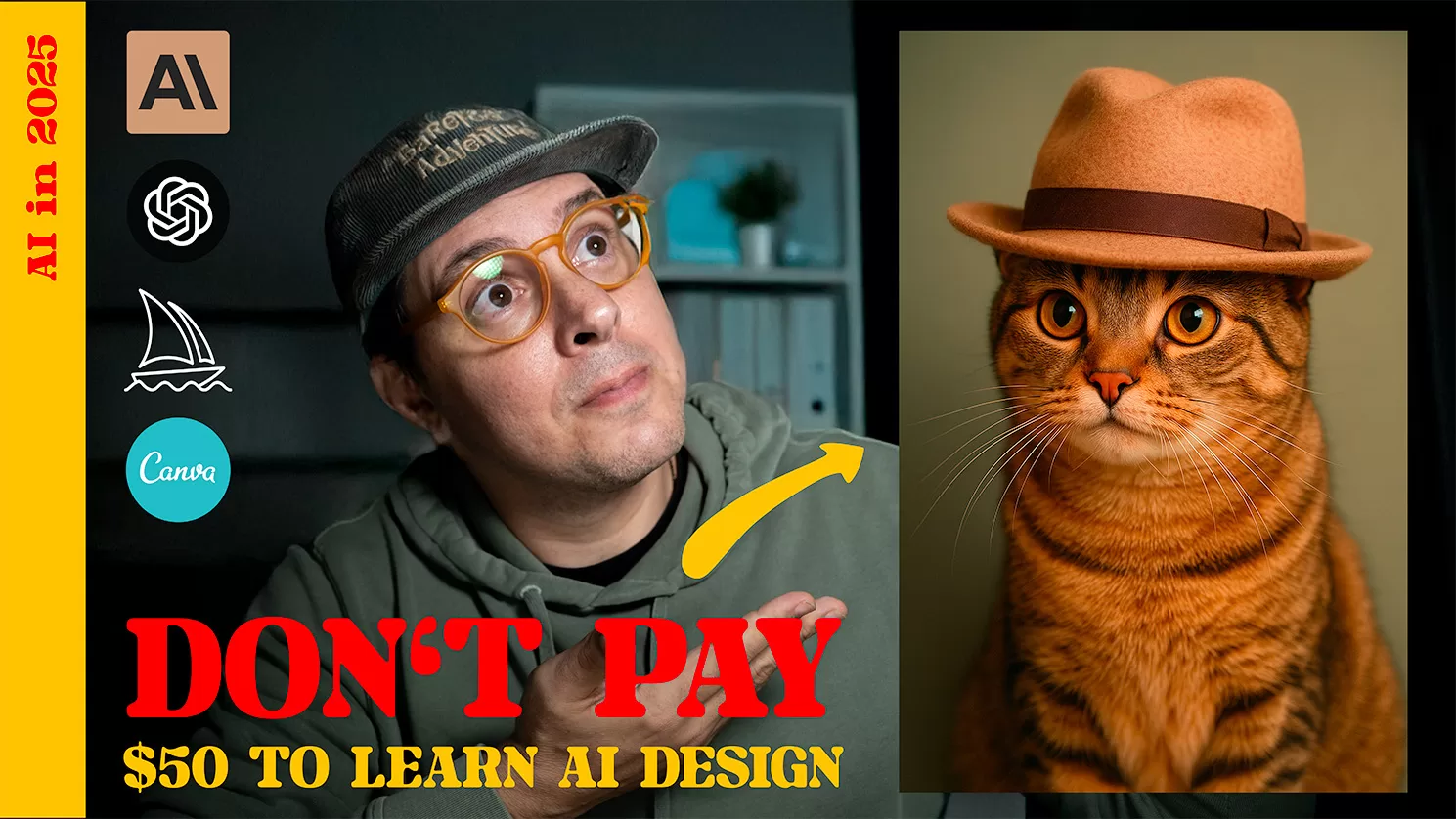
The $50 AI Design Scam: Why Most “Experts” Are Wrong About the Future of Graphic Design
How I tested Claude AI + Canva so you don’t have to waste money on overpriced courses
The Simple Question That Started Everything
Last night, while scrolling LinkedIn at 1 AM, I saw yet another “AI expert” selling a $50 course promising to “revolutionize your design game with one click” using ai design tools. The promise was tempting, but something felt off.
Why charge $50 to teach people how to click a button?
As someone who’s worked with design tools and helped startups build their visual identity, I got curious. What if I just tested these tools myself and shared what actually works? No course, no paywall, no BS – just honest insights about what you can realistically expect from AI design tools in 2025.
So I fired up Claude AI + Canva and put these tools through real-world testing. What I discovered will save you money and give you realistic expectations about the future of graphic design – whether you’re a designer embracing new tools or a startup looking for cost-effective solutions.
WHAT I DISCOVERED: AI Design Tools Are Useful, But Not Magic
The AI design space is exploding – Google Trends shows an unprecedented 1700% increase in search volume for AI design tools from 2022 to 2023. With this much interest, it’s no wonder people are looking for guidance.
Here’s what my testing revealed: designs ai tools are genuinely helpful starting points, but they’re not the “one-click solutions” being sold. After extensive testing with Claude AI’s Canva integration, I found that current ai for designers capabilities produce usable results in roughly 25% of attempts – which is actually pretty impressive for emerging technology.
REAL-WORLD TESTING: What Actually Works (And What Doesn’t)
Instead of selling you a course, let me share exactly what happened when I tested these tools with three common design needs:
The Three-Test Challenge
I tested the tools with scenarios any business might face:
- A minimalist logo (more complex than it sounds)
- A product flyer with specific requirements
- A business card with proper information hierarchy

The results? One solid design out of four attempts, two that were starting points with potential, and one that was… well, let’s just say I accidentally created the most professional cat portrait of 2025.
The key insight: These tools work best when you understand their strengths and limitations, not when you expect magic.
WHY AI + HUMAN CREATIVITY IS THE WINNING COMBINATION
The future of graphic design industry isn’t about replacement – it’s about collaboration. Deloitte research shows that 57% of business leaders predict AI will “substantially transform” their company within three years, but here’s what’s interesting: 60% of today’s workers are employed in occupations that didn’t exist in 1940.
Technology creates new opportunities rather than just eliminating old ones.
The Sweet Spot: Where AI Excels
AI design tools are genuinely impressive at:
- Rapid iteration and concept generation
- Automating tedious technical tasks
- Creating multiple variations quickly
- Handling basic layout suggestions
- Ai logo design free options for tight budgets
Where Human Input Still Rules
But they need human guidance for:
- Strategic brand thinking
- Understanding target audiences
- Cultural context and emotional resonance
- Making sense of what “good” looks like for your specific goals
Recent studies show that 76% of firms are planning to adopt AI into their workflows, but they’re using it as enhancement, not replacement. Smart approach.
THE SMART WAY TO USE AI FOR BRANDING AND MARKETING
Here’s where things get really interesting. The biggest misconception about ai for branding and marketing isn’t that it can’t help – it’s that people expect it to do everything.
Gartner reports that 30% of generative AI projects will be abandoned after proof of concept by the end of 2025, usually because companies ask AI to handle strategic decisions it’s not designed for.
How Successful Brands Use AI
The smartest branding and ai integration I’ve seen works like this:
- AI handles data analysis and pattern recognition
- Humans interpret insights and make strategic decisions
- AI executes tactical implementations quickly
- Humans ensure brand consistency and emotional connection
AI and brand management becomes powerful when you use each tool for what it does best. By 2025, 30% of marketing messages from large organizations will use AI generation, but the strategy behind those messages? That’s still human territory, and rightfully so.
GREAT NEWS: The Future is Bright for Everyone
Contrary to scary headlines, the future of graphic designer roles and future of graphic designing is actually expanding. Industry analysis shows that 90% of creators report increased productivity when using AI tools, and productivity gains typically create new opportunities rather than eliminate jobs.
The Evolving Skill Set
Whether you’re a designer or a business owner, here’s what’s becoming valuable:
- AI Tool Fluency: Understanding when and how to use ai logo design and other automated capabilities
- Strategic Thinking: Knowing what you want to achieve before you start clicking
- Quality Assessment: Being able to tell when AI output is good enough vs when it needs human refinement
- Creative Direction: Guiding tools toward your specific goals
The research is clear: AI might not replace people, but people who understand AI will have advantages over those who don’t. That’s not threatening – that’s just the reality of technological progress.
MONEY-SAVING INSIGHTS: What You Actually Get for Free
Let me break down the real economics of ai logo design free options versus paid alternatives, because this is where you can save serious money.
My testing revealed:
The Honest Cost-Benefit Analysis:
- Free AI Tools: 25% success rate, but require 2-3 hours of tweaking to get professional results
- $50 “Expert” Courses: Teach you button-clicking that you can learn in 10 minutes on YouTube
- Professional Designer + AI Tools: 85% success rate, includes strategic thinking
The math is simple: For basic needs with time to experiment, free AI tools are fantastic. For complex branding that needs to perform in the market, human expertise combined with AI efficiency is your best bet.
But here’s what no course seller will tell you: the free option is often perfectly adequate for startups, side projects, and rapid prototyping.
THE EXCITING FUTURE: Hybrid Creative Intelligence
The most exciting development isn’t AI replacing human creativity – it’s the emergence of hybrid workflows where strategic thinking guides smart automation. Current trends show AI integration in design is permanent and accelerating.
Real Companies Doing This Right
Airbnb uses AI to generate production-ready code from hand-drawn wireframes. Netflix uses AI for artwork personalization and banner localization. These aren’t scary replacements – they’re smart augmentations that free up humans for higher-level creative work.
Adobe reports that designers are increasingly using AI as creative assistants for inspiration, ideation, and finishing touches. The key insight: AI amplifies existing skills rather than replacing them.
When tools and humans work together intelligently, both sides win.
The Sustainability Revolution: Why Anti-AI Design Trends Matter
In rebellion against AI-generated imagery, we’re seeing shifts toward earthy, analog aesthetics using organic lettering, earthen textures, and hand-crafted elements. This isn’t anti-technology sentiment – it’s strategic differentiation.
Smart brands are using this tension productively:
- AI for rapid prototyping and iteration
- Human craft for final brand expression
- Sustainable design practices that conserve resources
- Authentic storytelling that resonates emotionally
The Truth About AI Video and Motion Graphics
While still images show promise, AI video capabilities remain limited. My testing with InVideo AI required 15 hours to generate basic content, with pacing and voice quality that felt distinctly artificial. Professional videography remains safely in human hands – for now.
However, tools like Google’s Veo 3 demonstrate impressive capabilities for short-form content. The key is understanding appropriate applications rather than expecting universal solutions.
Our Predictions That Will Define the Next Decade
By 2027:
- Design AI tools will achieve 60% success rates for basic layouts
- Human designers will focus primarily on strategy and creative direction
- Hybrid workflows will become industry standard
- AI-generated content will require disclosure labeling
By 2030:
- AI for designers will handle 80% of technical execution
- Brand strategy will become increasingly humanized in response
- New designer roles will emerge focused on AI creative direction
- The industry will stabilize around human-AI collaboration
The Accessibility Revolution
AI tools are making high-quality design accessible to everyone, enabling non-designers like you to create professional visuals while helping developers write cleaner code. This democratization creates opportunities rather than threats for professional designers.
Small businesses gain access to basic design capabilities, while designers focus on complex strategic challenges that AI cannot address. It’s market expansion, not market cannibalization.
Why Course Sellers Miss the Point Entirely
Here’s what the $50 course industry doesn’t understand: design isn’t just technical execution. It’s strategic communication, cultural interpretation, emotional psychology, and brand storytelling.
You can’t reduce that to “one-click solutions” or automated workflows. The course sellers are selling shortcuts to a destination that requires understanding, not just clicking.
The real value isn’t in learning which button to press – it’s in understanding when AI output is working for your goals and when it isn’t. That judgment comes from experience and understanding your audience, not from following someone else’s template.
The Smart Path Forward
Studies show that understanding AI limitations creates competitive advantages. Here’s how smart brands and designers are using these tools:
Strategic Applications That Work:
- Rapid Prototyping: AI for quick concept generation and iteration
- Asset Efficiency: Automate repetitive technical tasks
- Market Research: Use AI for initial data analysis and trends
- Workflow Optimization: Streamline production processes
Where Human Expertise Remains Essential:
- Brand Strategy Development
- Cultural Context and Audience Understanding
- Emotional Storytelling and Messaging
- Quality Assessment and Creative Direction
The Ethics of AI-Generated Content
AI video tools can create user-generated content and fake reviews, raising serious ethical concerns about the line between reality and fiction. Professional designers and agencies must establish ethical guidelines for AI usage, including transparency about AI-generated elements and disclosure requirements.
The industry needs self-regulation before external regulation is imposed. This responsibility falls on professionals who understand both the capabilities and implications of these tools.
Building Sustainable AI-Enhanced Design Brand
The goal isn’t to avoid AI or fully embrace it – it’s to build sustainable practices that leverage artificial intelligence while maintaining human creative integrity.
Best Practices for Brands:
- Use AI for ideation and iteration
- Maintain human oversight for all strategic decisions
- Establish clear ethical guidelines
- Train teams on AI tool proficiency
Best Practices for Startups:
- Leverage free AI tools for basic needs
- Invest in professional strategy as you scale
- Understand when to transition from AI to human expertise
- Build brand guidelines that work with AI tools
The Future Belongs to the Strategically Informed
Success in 2025 will belong to brands that can harness generative AI while maintaining authentic connections with their audiences. This requires understanding both the potential and limitations of artificial intelligence in creative applications.
The designers and brands that thrive will be those who:
- Understand AI capabilities and limitations intimately
- Develop hybrid workflows that leverage both human and artificial intelligence
- Focus on strategic value creation rather than technical execution
- Maintain ethical standards in AI usage
- Educate clients about appropriate AI applications
Conclusion: Why I’m Excited (And Slightly Terrified) About the Future
After extensive testing and industry analysis, I’m convinced that AI will fundamentally transform design workflows while simultaneously creating new opportunities for human creativity. The future of graphic design industry isn’t about choosing between human and artificial intelligence – it’s about orchestrating them strategically.
The $50 course sellers are wrong about almost everything. They’re selling automation when they should be teaching strategy. They’re promising replacement when they should be enabling enhancement. They’re monetizing fear when they should be building understanding.
The real opportunity lies in developing deep expertise in both human creativity and AI capabilities. Those who master this hybrid approach will create competitive advantages that pure AI or pure human approaches cannot match.
The revolution isn’t coming – it’s here. The question is whether you’ll be informed enough to navigate it successfully.